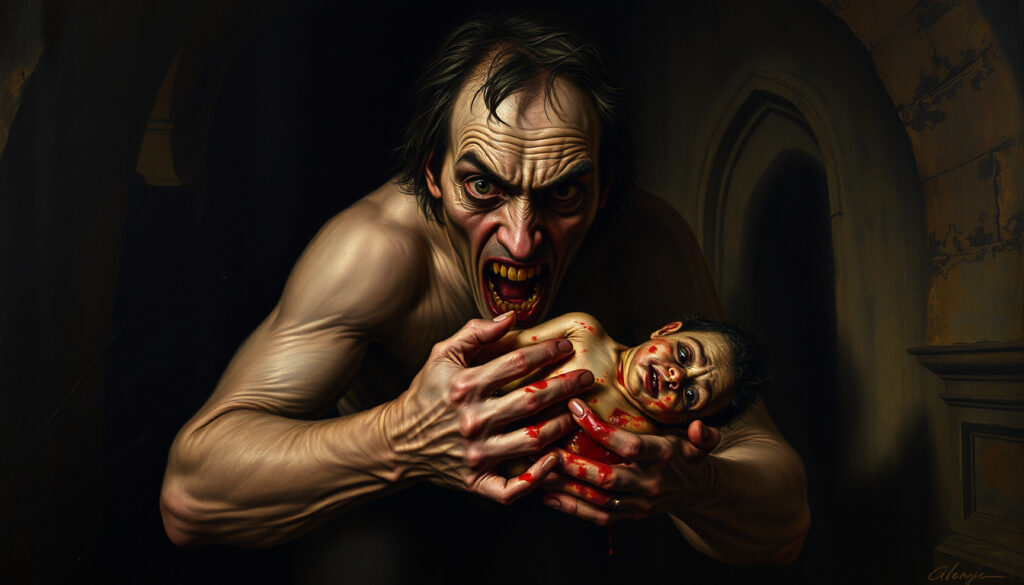
Goya Saturn Devouring His Son: Symbolism, Meaning, and Location
Few paintings grab you by the throat the way Goya’s Saturn Devouring His Son does. Painted between 1819 and 1823 on the wall of his villa, it shows the Roman god devouring his own child—a scene so raw it still unsettles viewers two centuries later.
Artist: Francisco Goya ·
Year painted: 1819–1823 ·
Series: Black Paintings (14 works) ·
Medium: Oil on wall, later transferred to canvas ·
Dimensions: 143.5 cm × 81.4 cm ·
Location: Museo Nacional del Prado, Madrid
Quick snapshot
- Artist: Francisco Goya (Web Gallery of Art (art database))
- Year: 1819–1823 (Britannica (authoritative encyclopedia))
- Media: Oil mural transferred to canvas (Museo del Prado (Spanish national art museum))
- Dimensions: 143.5 x 81.4 cm (Web Gallery of Art) (Web Gallery of Art (art database))
- Museo del Prado, Madrid (Museo del Prado)
- Room 067 (Black Paintings room) (Museo del Prado)
- Part of bequest to the Spanish state (Web Gallery of Art)
- Roman god Saturn (Cronus) devouring his child (Britannica (authoritative encyclopedia))
- Act to avoid usurpation (Britannica) (Britannica (authoritative encyclopedia))
- Painted during Spain’s political crisis (Web Gallery of Art (art database))
- One of 14 Black Paintings (Web Gallery of Art)
- Painted directly on wall of Quinta del Sordo (Museo del Prado)
- Last major works before Goya’s death (Web Gallery of Art)
Eight key facts about the painting, from its creation to its current home:
| Attribute | Detail |
|---|---|
| Date created | 1819–1823 (Web Gallery of Art) |
| Original location | Quinta del Sordo, Madrid (Museo del Prado) |
| Current location | Museo del Prado, Madrid (Museo del Prado) |
| Medium | Oil on canvas (transferred from wall) (Museo del Prado) |
| Dimensions | 143.5 cm × 81.4 cm (Web Gallery of Art) |
| Series | Black Paintings (Web Gallery of Art) |
| Related myth | Saturn (Cronus) devouring his child (Britannica) |
| Artist’s age at creation | 73–77 years old (Web Gallery of Art) |
What does Goya’s Saturn symbolize?
Saturn as a political allegory
- The painting draws on the Roman myth of Saturn (Cronus) eating his children to prevent usurpation (Britannica).
- Art historians argue Goya used this myth to critique the political violence and famine in Spain during the Trienio Liberal (1820–1823) (Artnet News (art journalism)).
- The work is part of Goya’s private Black Paintings series, created on the walls of his villa, the Quinta del Sordo (Museo del Prado).
The implication: Goya turned a myth about power into a mirror for his own country’s self-destruction. The god’s wide-eyed stare suggests madness and paranoia, according to Britannica—a look that belongs as much to a decaying regime as to a mythical tyrant.
Goya’s Saturn is a god who cannot stop himself—much like the Spanish monarchy of his time, devouring its own people to stay in power. The painting hung in Goya’s dining room, meaning he ate his meals under that image every day.
TL;DR: Goya’s Saturn served as a political allegory for Spain’s self-destruction during the Liberal Triennium, using the myth to expose the monarchy’s cannibalistic grip on power.
Saturn as a reflection of Goya’s despair
- Interpretations range from parental guilt to a representation of time devouring all things (Britannica).
- Some scholars see it as a metaphor for the Spanish state devouring its citizens (Artnet News).
- Goya’s deteriorating mental health may have influenced the grim imagery (Highpole.Club (arts analysis)).
What this means: the painting works on multiple levels. It is a political cartoon, a psychological self-portrait, and a meditation on mortality—all compressed into one savage image.
TL;DR: The painting functions as a layered commentary – simultaneously political, psychological, and existential – reflecting Goya’s personal despair and the broader Spanish crisis.
What is the interpretation of Goya’s Saturn devouring his children?
Psychological interpretation
- According to Artnet News, the figure seems aware of the monstrosity of the act while committing it, as if trapped in a compulsion.
- The god’s wide-eyed stare suggests madness and paranoia (Britannica).
- Some readings interpret the painting as Saturn representing Time devouring all things (Britannica).
The catch: no single interpretation is conclusive. Goya never explained the meaning, leaving the painting open to endless analysis.
Historical context of the painting
- Painted between 1820 and 1823 during the Liberal Triennium in Spain (Web Gallery of Art).
- Spain was experiencing civil strife between absolutists and liberals, leading to famine and violence (Wikipedia (encyclopedic summary)).
- The painting was part of a series of 14 murals that decorated Goya’s villa, not intended for public display (Museo del Prado).
Why this matters: the private, uncommissioned nature of the Black Paintings means they likely represent Goya’s unfiltered thoughts. This wasn’t art for a patron—it was art for himself.
Is Saturn Devouring His Son by Rubens or Goya?
Two versions of the same myth exist, with stark differences. Four key contrasts:
| Attribute | Goya’s version | Rubens’ version |
|---|---|---|
| Artist | Francisco Goya (Web Gallery of Art) | Peter Paul Rubens (Britannica) |
| Date | 1819–1823 (Web Gallery of Art) | 1636–1638 (Britannica) |
| Style | Dark, visceral, loose brushwork (Britannica) | Classical, composed, Baroque chiaroscuro (Britannica) |
| Medium | Oil on wall (later transferred to canvas) (Museo del Prado) | Oil on canvas (Britannica) |
| Location today | Museo del Prado, Madrid (Museo del Prado) | Museo del Prado, Madrid (Britannica) |
| Mood | Horror, madness, raw emotion (Britannica) | Dramatic but controlled (Britannica) |
The pattern: Rubens treats the myth as a theatrical scene from antiquity; Goya transforms it into a psychological horror show. One is a Baroque set-piece, the other a modern confession.
Where is the original painting of Saturn Devouring His Son?
Museo del Prado location details
- The painting is housed in the Museo Nacional del Prado, Madrid, Spain (Museo del Prado).
- It resides in Room 067, dedicated to the Black Paintings series (Museo del Prado).
- The Prado acquired the paintings as a donation from Baron Émile d’Erlanger in 1881 (Web Gallery of Art).
What this means: the painting that once terrified visitors to Goya’s private home is now one of the most-visited works in Spain’s national museum.
How the painting was transferred to canvas
- Originally painted on the wall of Goya’s villa, Quinta del Sordo (Museo del Prado).
- In 1874, the fresco was transferred to canvas for preservation by Baron Émile d’Erlanger (Web Gallery of Art).
- The transfer was a delicate process that saved the mural from deterioration (Web Gallery of Art).
The trade-off: removing the painting from its original wall stripped it of its architectural context—Goya intended it to be seen in a specific room, not on a museum wall.
What was Goya’s mental illness?
Historical medical theories
- Goya suffered a severe illness in 1792 that left him permanently deaf (Web Gallery of Art).
- Wikipedia notes theories include lead poisoning, encephalitis, or a neurological condition such as dementia.
- No definitive diagnosis exists today (Wikipedia).
The implication: the paintings we see from his old age are filtered through a body that was failing and a mind that may have been unravelling.
Impact of illness on his late works
- His later works, particularly the Black Paintings, are often analyzed through the lens of his physical and mental decline (Artnet News).
- The distorted forms and raw emotion reflect Goya’s departure from Neoclassical conventions (Britannica).
- Some historians link the violent imagery to Goya’s reported depression and isolation after his deafness (Artnet News).
Why this matters: the Saturn painting is not just about mythology—it is the product of a mind that had experienced trauma, isolation, and the horror of a country tearing itself apart.
The painting isn’t just about myth; it’s a self-portrait of an artist staring into his own madness, painted on the wall of the house where he lived alone after going deaf.
Timeline: Goya, the Black Paintings, and Saturn
- 1792: Goya falls seriously ill, becomes permanently deaf (Web Gallery of Art).
- 1819: Goya purchases Quinta del Sordo villa outside Madrid (Web Gallery of Art).
- 1819–1823: Paints the 14 Black Paintings directly onto villa walls, including Saturn Devouring His Son (Web Gallery of Art).
- 1824: Goya goes into voluntary exile in Bordeaux, France (Britannica).
- 1828: Goya dies in Bordeaux (Britannica).
- 1874: Black Paintings are transferred from villa walls to canvas by Baron Émile d’Erlanger (Web Gallery of Art).
- 1881: Black Paintings donated to the Prado Museum (Web Gallery of Art).
The pattern: Goya’s life tracks from illness to isolation to exile—and the Black Paintings mark the darkest point of that arc, created in the house he bought after retreating from public life.
Confirmed facts
- Goya painted Saturn Devouring His Son between 1819 and 1823 (Web Gallery of Art).
- The painting is one of the 14 Black Paintings (Web Gallery of Art).
- The myth depicted is Saturn (Cronus) devouring his child (Britannica).
What’s unclear
- The exact order of creation of the Black Paintings is unknown (Wikipedia).
- Goya’s specific mental illness diagnosis remains disputed (Wikipedia).
- The precise symbolic meaning Goya intended for the painting is not documented (Britannica).
- The painting’s original dimensions are sometimes cited as 146 x 83 cm (Prado cataloging tradition).
- The painting’s original placement in Goya’s dining room is based on later accounts, not contemporaneous evidence.
Voices on the painting
“The Black Paintings are a unique cycle in Western art—painted freehand on plaster, never intended for exhibition, they reveal Goya’s innermost thoughts in a way no commissioned work could.”
“Goya’s Saturn is not a god of strategy but a creature overwhelmed by the need to preserve power—the act is monstrous, and he knows it.”
“The illness that struck Goya in 1792 left him deaf and isolated. Whether it was lead poisoning from his paints or a neurological infection, it changed the trajectory of his life and work forever.”
“Saturn Devouring His Son may be read as divine wrath, the conflict between youth and old age, or time consuming all things—but its power comes from its refusal to settle on any single meaning.”
— Britannica (art history entry)
For anyone standing before Saturn in the Prado, the choice is between seeing a myth of power or a confession of despair. Goya likely intended both—and that ambiguity is what makes the painting endure. For the art lover in Madrid, the visit to Room 067 is not just a look at a painting; it is an encounter with the darkest corner of one of Spain’s greatest minds.
britannica.com, 34st.com, estherschipper.com, instagram.com, reddit.com, reddit.com, en.wikipedia.org
For a deeper look at the historical context and artistic techniques, see this detailed analysis of the painting.
Frequently asked questions
Is Saturn Devouring His Son Goya’s most famous painting?
It is one of his most recognized works, alongside The Third of May 1808. The Black Paintings series as a whole attracts heavy attention, but Saturn is arguably the most iconic within that set (Britannica).
Why is Saturn Devouring His Son considered disturbing?
The painting depicts cannibalism in raw, unsparing detail: the god’s wide eyes, the blood, the partial consumption of the child’s body. Its placement in a domestic setting (a dining room) adds to the discomfort (Highpole.Club).
How was the painting transferred from wall to canvas?
In 1874, Baron Émile d’Erlanger commissioned a transfer: the plaster layer was removed from the wall, attached to canvas using a glue-and-linen method, and then mounted on a stretcher (Web Gallery of Art).
Who owns the Saturn Devouring His Son painting?
The painting is owned by the Spanish state and housed in the Museo del Prado, as part of the bequest from Baron d’Erlanger (Museo del Prado).
What other paintings are in Goya’s Black Paintings series?
The series includes 14 works, such as Witches’ Sabbath, The Dog, Judith and Holofernes, and Two Old Men Eating Soup. All were painted on the walls of the Quinta del Sordo (Web Gallery of Art).
Did Goya explain the meaning of Saturn Devouring His Son?
No. Goya left no written explanation for any of the Black Paintings. Their meanings are entirely left to interpretation by viewers and scholars (Britannica).
Is Saturn Devouring His Son based on a true story?
No. It is based on the Roman myth of Saturn (Cronus), who swallowed his children to prevent a prophecy that he would be overthrown by one of them (Britannica).
More related posts
 Zack Snyder: Biography, Movies, Personal Tragedy
 Peter Boyle: Cause of Death, Friendships, and Career Highlights
 Robin Williams’ Death: Cause, Autopsy, and Final Moments
 Quebec Sales Tax Calculator – QST GST Rates Guide 2024
 Chrissy Metz: Weight Loss, Health, and Personal Life Explained
 Biggie Smalls Death: The Unsolved Murder of Notorious B.I.G.
 Neil Peart: Legacy, Death, and Drumming Greatness Explored
 Redmi 2 Prime to Buy: Cheap Prices, Specs & Issues