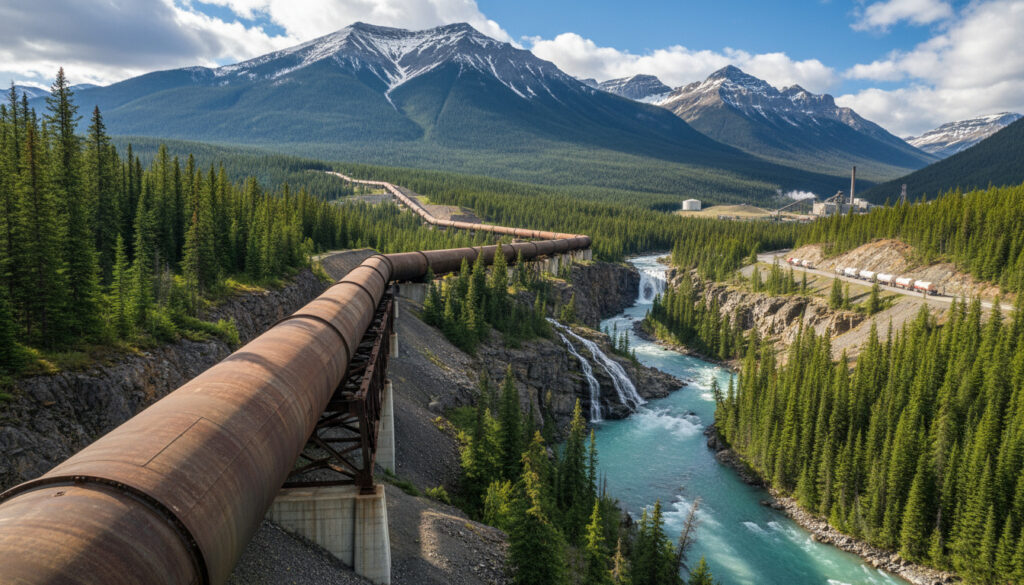
Trans Mountain Pipeline News – Latest Key Developments
Trans Mountain Expansion Begins Commercial Operations
The Trans Mountain Pipeline expansion commenced commercial service on May 1, 2024, concluding a 12-year regulatory and construction odyssey that tripled capacity to Canada’s Pacific coast. The $34 billion project now transports up to 890,000 barrels of crude oil daily from Edmonton to Burnaby, British Columbia, fundamentally altering Western Canada’s export logistics.
Project at a Glance
- Capacity increased from 300,000 to 890,000 barrels per day
- 1,150-kilometre twin pipeline following the existing right-of-way
- Investment of approximately $34.4 billion by Canadian taxpayers
- First tanker departed Westridge Marine Terminal in June 2024
- Current ownership retained by Trans Mountain Corporation, a federal Crown corporation
Strategic Implications
The expansion addresses a long-standing bottleneck that forced Canadian producers to rely heavily on the U.S. market. With direct access to Asian markets via the Westridge terminal, the project reduces dependence on midwestern refineries and potentially narrows the price discount that Western Canadian Select crude typically trades at against West Texas Intermediate. Analysts estimate the additional tidewater capacity could reduce transportation costs by $5 to $10 per barrel for Canadian producers.
The federal government’s 2018 purchase of the pipeline for $4.5 billion, followed by the decision to expand rather than sell, represented an unprecedented intervention in Canadian energy infrastructure. Ottawa has indicated plans to eventually divest the asset, though timing remains uncertain pending stabilization of operations and market conditions.
Technical Specifications
| Metric | Original Pipeline | Expanded System |
|---|---|---|
| Daily Capacity | 300,000 barrels | 890,000 barrels |
| Storage Capacity | 5.6 million barrels | 9.5 million barrels |
| Pump Stations | 12 | 19 |
| Terminals | 3 | 4 (including expanded Westridge) |
| Construction Period | 1953 | 2019-2024 |
Operational Complexity
The twinning project involved laying nearly parallel pipe through mountainous terrain and urban corridors, requiring extensivehorizontal directional drilling beneath residential areas and watercourses. Construction faced delays from pandemic disruptions, supply chain constraints, and flooding in the Fraser Valley, pushing completion two years beyond initial projections.
Safety systems include advanced leak detection technology, automated shut-off valves at 22-kilometre intervals, and double-hulled tanker requirements for marine transport. The Pipeline and Tanker Safety Program now regulates simultaneous operations on both lines, maintaining separate integrity management protocols for the 71-year-old original pipe and the new installation.
Construction Milestones
- : Kinder Morgan announces expansion proposal
- : Federal cabinet approves project subject to 157 conditions
- : Federal government acquires pipeline from Kinder Morgan
- : Federal Court of Appeal quashes initial approval; additional Indigenous consultation ordered
- : Construction begins in Alberta
- : B.C. section construction accelerates
- : Mechanical completion achieved; commissioning begins
- : First post-expansion tanker loads at Burnaby terminal
Ownership and Regulatory Context
Despite Conservative calls for immediate privatization, the Liberals have maintained Crown ownership to ensure construction completion. The parliamentary budget officer previously estimated the pipeline’s value at roughly $15 billion, suggesting significant paper losses on the government’s investment, though methodology remains contested regarding future toll revenue and market scenarios.
The Canada Energy Regulator oversees compliance with the 156 conditions attached to the certificate of public convenience and necessity. These encompass environmental protections, Indigenous monitoring programs, and financial liability requirements. Twenty Indigenous communities hold either equity stakes or long-term benefit agreements, though several First Nations along the route continue legal challenges regarding consultation adequacy.
Market Analysis
With 590,000 barrels per day of incremental export capacity, the expansion arrives as Alberta production reaches record highs. The additional outlets have already compressed the Western Canadian Select differential, with heavy crude pricing improving relative to U.S. benchmarks. traders anticipate the pipeline will reach contracted capacity within six months of operations, given committed shipper agreements representing 80% of available space.
Downstream effects include reduced apportionment on the Enbridge Mainline system and potential impacts on U.S. Gulf Coast refining margins as Canadian heavy crude becomes available to Asian markets. The project also factors into pipeline infrastructure capacity calculations for future oil sands expansion decisions, with producers now able to contract for 20-year shipping terms.
Industry Perspectives
“This project provides Canada with the energy security and market diversity we have pursued for decades. The completion demonstrates that major infrastructure can advance when supported by rigorous environmental standards and Indigenous partnerships.”
— Trans Mountain Corporation, Commercial Operations Announcement, May 2024
Environmental organizations maintain opposition despite operational commencement. Climate campaigners argue the expansion locks in fossil fuel dependence for decades, conflicting with national emissions reduction targets. The British Columbia government continues monitoring marine spill response capabilities, noting that tanker traffic through Burrard Inlet will increase from roughly one per week to one daily.
Summary
The Trans Mountain expansion represents the most significant energy infrastructure addition in modern Canadian history, altering export dynamics for the world’s fourth-largest oil reserve holder. While operational risks and ownership questions persist, the pipeline now functions as a physical link between Alberta’s oil sands and Pacific markets, ending years of transportation constraints. The project’s legacy will ultimately depend on utilization rates, eventual divestment outcomes, and the evolving global demand for heavy crude oil in an accelerating energy transition.
Frequently Asked Questions
What is the current daily capacity of the Trans Mountain Pipeline system?
The expanded system now transports up to 890,000 barrels per day, compared to the original 300,000 barrels per day capacity prior to the twinning project.
Who currently owns the Trans Mountain Pipeline?
Trans Mountain Corporation operates as a wholly owned subsidiary of the Canada Development Investment Corporation, making it a federal Crown corporation. The Government of Canada purchased the pipeline in 2018 to ensure the expansion proceeded.
What was the final cost of the expansion project?
The expansion cost approximately $34.4 billion, significantly exceeding initial estimates of $7.4 billion when the project was first proposed. Cost escalation resulted from construction delays, route changes, regulatory requirements, and pandemic-related inflation.
When did construction begin and end?
Major construction began in early 2020 following regulatory approvals and the resolution of legal challenges. Mechanical completion was achieved on May 1, 2024, with commercial operations commencing immediately thereafter.
How does the expansion affect Canadian oil prices?
By providing access to Asian markets and reducing reliance on U.S. midwestern refineries, the pipeline typically reduces transportation discounts. Analysts estimate Canadian producers may gain $5 to $10 per barrel through improved market access and competition between buyers.
More related posts
 Virgin River Season 6 – Release Date, Cast and Plot Guide
 Members of Linkin Park: Original, Current & New Lineup 2024
 Alan Ritchson Movies and TV Shows: Full List & Streaming Guide
 Golden State Warriors vs Chicago Bulls Match Player Stats
 Walk In Clinics Near Me in Ireland: Locations, Costs & Tips
 Best Arepa Paisa Near Me: Authentic Colombian Arepa Guide
 Hotel Riu Palace Costa Mujeres – All-Inclusive Resort Guide 2025
 Great Canadian Treasure Hunt 2026: $1M Gold Hunt Facts & Clues